What Is Audio Mastering and Do You Actually Need It?
What Is Audio Mastering and Do You Actually Need It?
You got your mix back and it sounds great in your headphones. Then someone tells you it needs to be “mastered.” Now you’re wondering what that even means and whether it’s worth spending more money on something that already sounds good to you.
Totally fair question.
What Mastering Actually Is
Audio mastering is the final step before your music goes out into the world. A mastering engineer takes your finished mix and prepares it for distribution. Spotify, Apple Music, vinyl, wherever people are going to hear it.
A simple way to picture it: your mix is a finished painting. Mastering is framing it, lighting it right, and hanging it where it looks its best. The painting doesn’t change. But how people experience it does.
In practical terms, a mastering engineer is adjusting overall EQ, managing dynamics with compression and limiting, setting the final loudness level, and making sure the track translates well across different playback systems — earbuds, car speakers, club systems, laptop speakers. They’re also catching small issues that are easy to miss after you’ve been staring at a mix for hours.
If you’re releasing an album or EP, mastering also makes sure every track flows together — consistent volume, tonal balance, spacing between songs. Without it, track three might feel twice as loud as track two, or the whole thing might sound disjointed.
Mixing vs Mastering — The Short Version
People confuse these constantly, so here’s the simplest way to think about it.
Mixing is about the individual elements inside your song. The vocal level, the drum sound, the guitar panning, the reverb on the snare. All of that is mixing. Your mix engineer is balancing dozens of tracks into one stereo file.
Mastering works on that stereo file as a whole. The mastering engineer isn’t adjusting your vocal level or adding reverb to individual instruments. They’re shaping the overall sound and preparing it for release.
What Mastering Does to Your Music
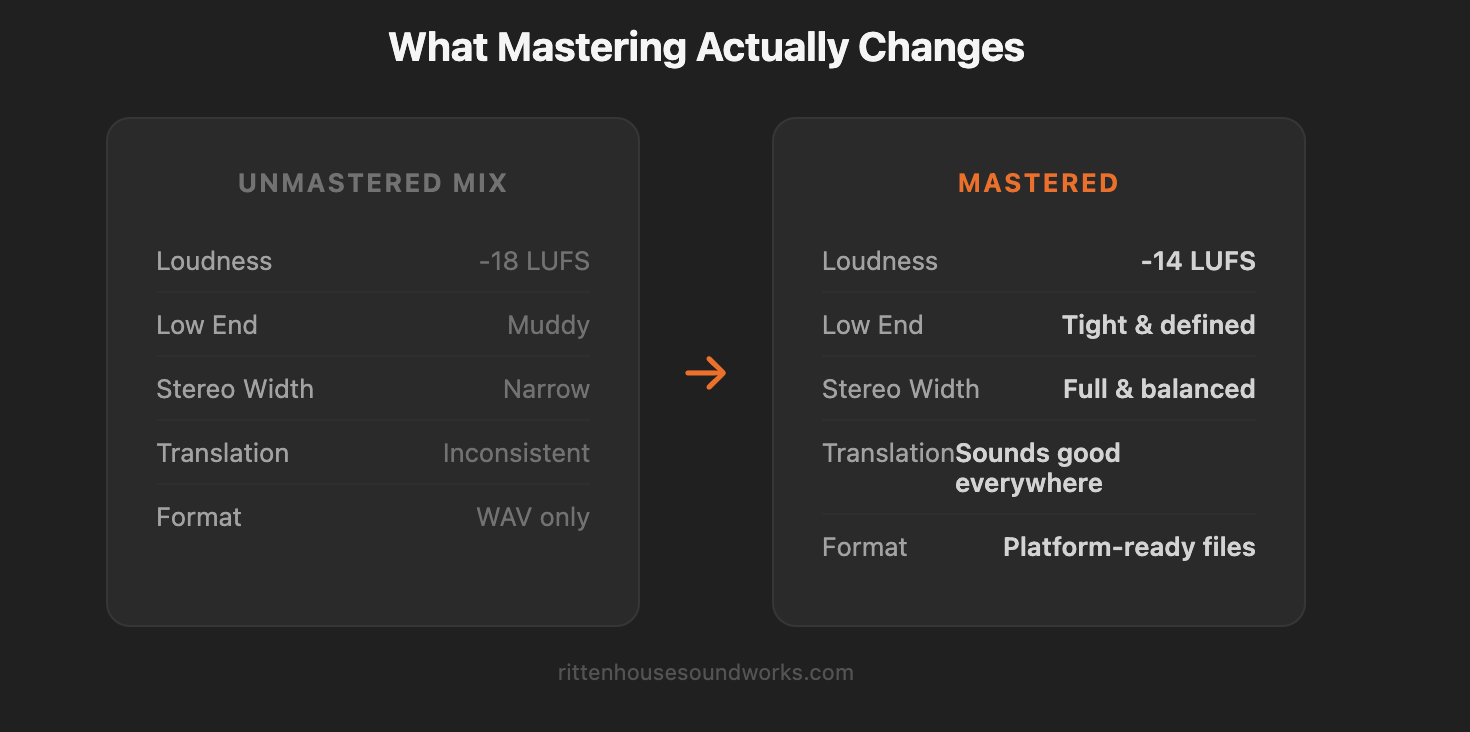
The difference between an unmastered and mastered track isn’t always dramatic, but it’s real. Here’s what changes:
Loudness and punch. Your unmastered mix is probably quieter than commercial releases. Mastering brings it up to competitive loudness without crushing the dynamics that make your music breathe.
Clarity across systems. That low-end rumble you can’t hear on your studio monitors? It’s there, and it’s eating up headroom. Mastering cleans up problems like that so your track sounds good everywhere, not just on the system it was mixed on.
Polish. Subtle EQ moves, stereo width adjustments, harmonic enhancement — small decisions that add up to a more polished, finished sound.
Format-ready files. Different platforms have different requirements. Mastering delivers the correct file formats, sample rates, and loudness standards for wherever your music is going.
When You Need Mastering
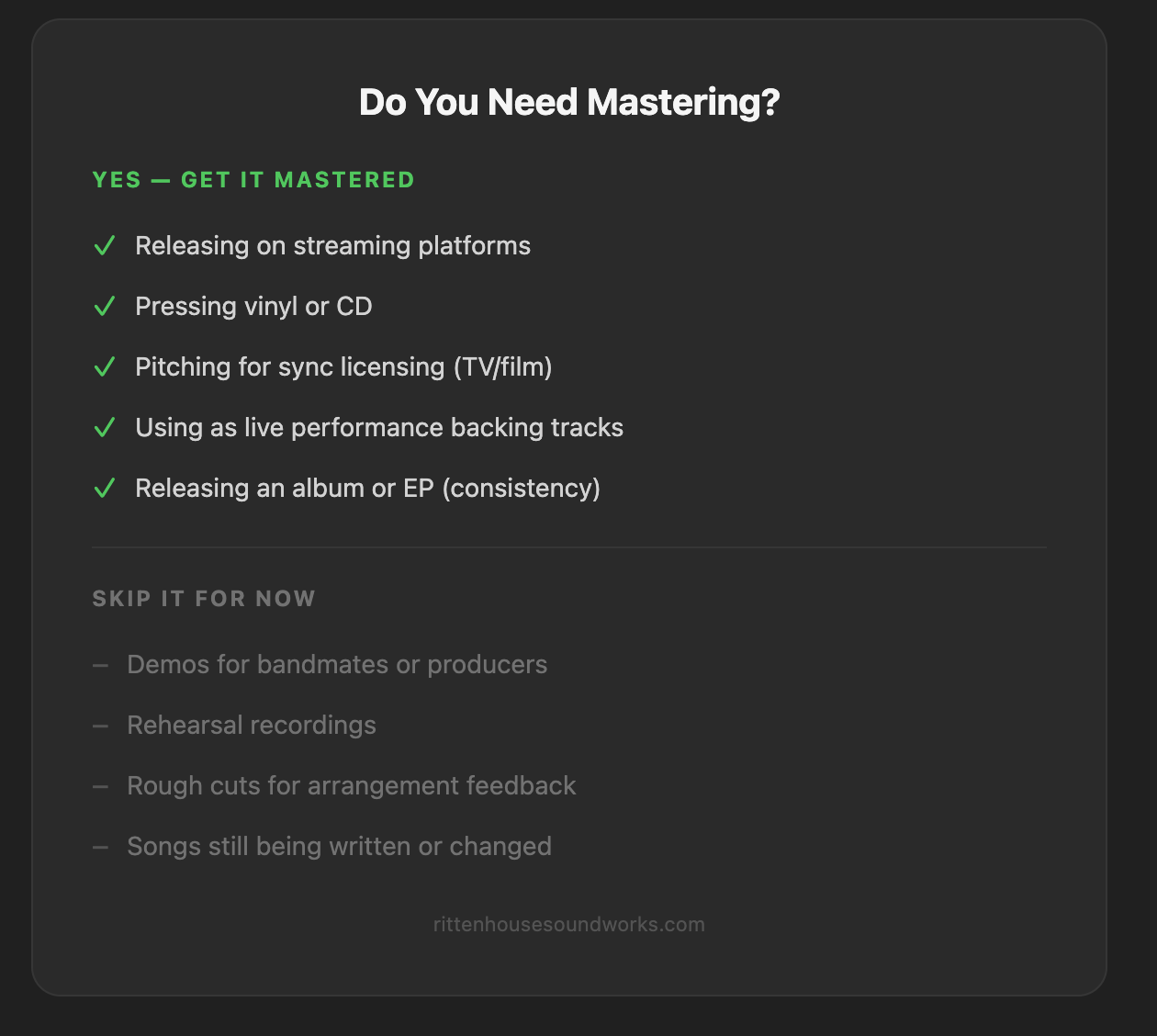
If your music is going somewhere public, you probably need it mastered. Specifically:
Streaming platforms. Spotify, Apple Music, Tidal all have loudness normalization, and a properly mastered track works with those algorithms instead of against them. Unmastered tracks can sound thin or inconsistent next to everything else in someone’s playlist. You can probably hear when something wasn’t mastered or mastered poorly when you are listening to a playlist on a streaming service and you hear a big loudness difference between tracks.
Physical releases. Vinyl and CD have specific technical requirements. Vinyl in particular needs careful attention to bass frequencies and dynamics. This isn’t optional — it’s part of getting the format to work the best it can.
Sync licensing. If you’re pitching music for TV, film, or ads, it needs to sound finished and professional. Music supervisors listen to hundreds of tracks. Yours shouldn’t be the one that sounds noticeably rougher than the rest.
Live performance backing tracks. If you’re playing to a track live, you want it to sound full and balanced through a PA system. Mastering can even help with that.
When You Might Not Need It
Not everything needs mastering.
Demos. If you’re sending rough ideas to bandmates or a producer, mastering is a waste of money. Save your budget for the final versions.
Practice recordings and rehearsal captures. These are functional, not finished products.
Rough cuts for feedback. Getting opinions on a song’s arrangement or structure? Mastering won’t change that feedback. Spend the money when the song is locked in.
If you’re still working on your budget, our breakdown of what recording actually costs covers how to prioritize your spending across the whole process.
DIY Mastering vs Professional Mastering
Services like LANDR, DistroKid’s built-in mastering, and CloudBounce use algorithms to master your track automatically. They’re fast and cheap — usually a few dollars per song. These are surpising pretty good at mastering. They don’t give you very much ability to fine tune things but if its the difference between you mastering a song or not, definitely try out one of these services.
They’re not terrible. For a single you’re releasing independently with a tight budget, algorithmic mastering will get you to a listenable place. It’ll be loud enough, it’ll be in the right format, and it won’t embarrass you.
It does have limits though. An algorithm doesn’t know your creative intent. It can’t tell if that bass is supposed to hit hard or if it’s a problem. It applies the same general processing to a folk ballad and a trap beat. It won’t catch the click at 2:47 or the phase issue in the chorus.
A mastering engineer listens to your music, understands what you’re going for, and makes decisions based on that context. They’ll also communicate with you — if the mix has an issue that should be fixed before mastering, they’ll tell you. That back-and-forth alone is worth something.
The gap between algorithmic and professional mastering has narrowed, but it hasn’t closed. For your most important releases, the ones you’re putting real effort behind, professional mastering is worth it.
Making the Call
The question isn’t really whether mastering matters — it does. The question is whether this particular project, at this particular stage, needs it.
If you’re releasing music that represents you as an artist, yes. Get it mastered properly. If you’re still figuring out the song, save your money and come back when it’s ready.
And if you’ve never been through the process before, check out our studio session tips so you know what to expect when you walk in.
When you’re ready to talk about mastering, or just want a second opinion on whether your track needs it, reach out. We’re happy to listen and tell you what we think. We can master music that is recorded at our studio or recorded elsewhere. Whatever you need!